
Why this exists

There is a stretch of work between choosing Google Cloud and having something governed actually running on it. Writing the Terraform. Wiring the service accounts. Setting the org policy. Connecting one application to the next. Almost every team does it privately from scratch.

It is also compressible: the same landing zone, the same database-behind-a-service pattern, the same connection string copied from one application's outputs into another's configuration. That is what RAD is: 350+ deployment options covering 190+ applications and platform modules, and 60+ pre-composed solutions.

RAD provisions into a Google Cloud project you own, under your organisation's policies, as plain Terraform — or, if you have no Google Cloud account, into a governed project RAD creates and manages for you. The same catalogue and engine serve both.
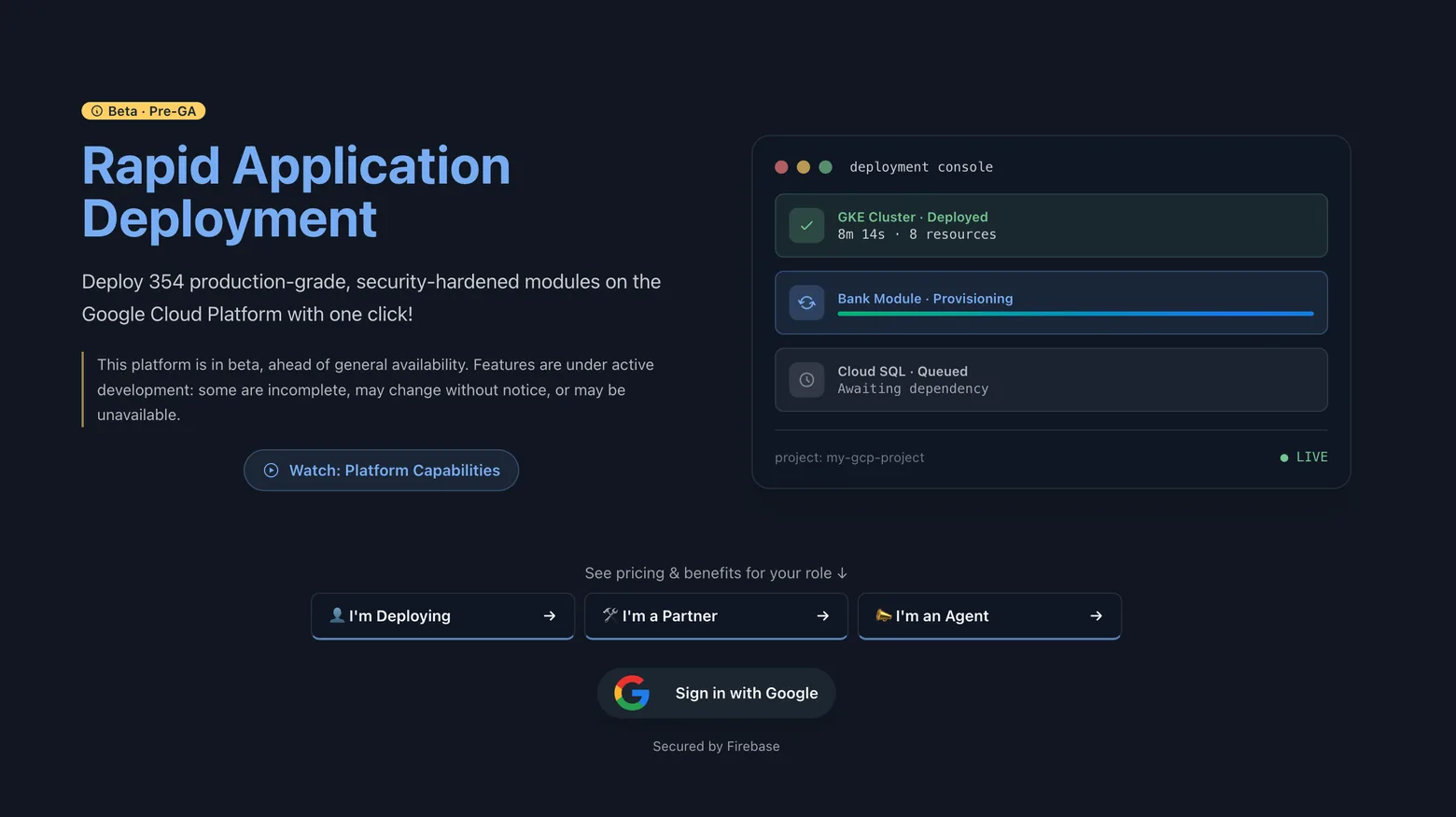
The RAD platform sign-in page: a Beta Pre-GA badge, the line Deploy 354 production-grade security-hardened modules on Google Cloud, a live deployment console showing a GKE cluster deployed and a module provisioning, and role-based entry points
Where it starts: the platform itself, stating what it deploys and admitting in the same breath that it is pre-GA.

Where we are

RAD is in beta. The platform is built and running, the catalogue and the documentation are real and countable, and we are early.

Built and running today

The catalogue and the deployment engine. Credits, subscriptions and two payment providers. RAD-managed Google Cloud projects across four governed tiers in eight regions. The labs and module documentation, all of it published and readable without an account.

Continuous innovation

Cohort provisioning and the trainer role shipped in August 2026 and are early access. Automatic copying of one solution member's outputs into the next member's configuration is designed, and defined per producer-and-consumer pair; the remaining members take their configuration from the form.

What we are unable to share

No user counts, no deployment counts, no growth or retention figures, no revenue, no logos, no quotes from people we have worked with. Everything here is a capability or a count of what exists. RAD has been used to develop demos for Google Cloud training programmes, and was only recently made public.

What we have built

Counted from the catalogue and the documentation.

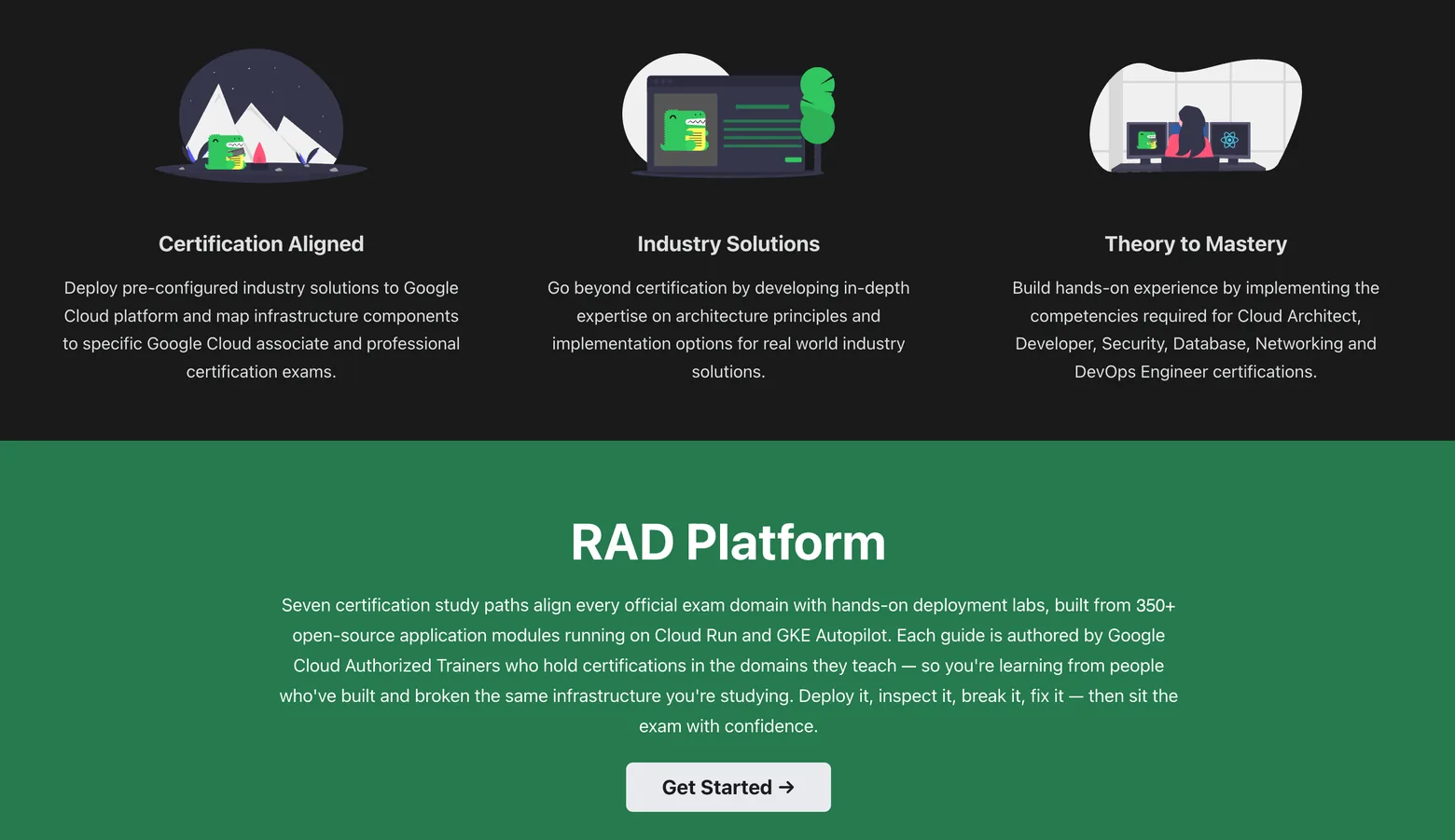
The RAD documentation site: three pillars headed Certification Aligned, Industry Solutions and Theory to Mastery, above a RAD Platform band describing seven certification study paths aligned to hands-on deployment labs
The documentation is organised around three jobs: passing the exam, building the industry solution, and getting from theory to something you have actually run.

Catalogue

  • Deployment options350+
  • Distinct modules190+
  • Pre-composed solutions60+
  • Member deployments290+
  • Solution categories12

Where it deploys

  • Your own projectEvery Google region
  • RAD-managed project tiers4
  • RAD-managed regions8
  • Only African regionafrica-south1
  • Eligible for a managed projectAll but a short, named list

Documentation

  • Hands-on labs345+
  • Module config guides520+
  • Certification study guides40+
  • Certification tracks covered7
  • Behind a sign-inNone of it

Paying for it

  • Payment providers2
  • Methods beyond cardBank transfer, USSD, mobile money
  • Card details handled by RADNever
  • Credit balances3
  • Credits bought outrightNever expire

The company

UK-registered, and precise about what it is entitled to say.

Legal entity

  • Registered nameTech Equity Cloud Services Ltd
  • Company number13561408
  • Registered inEngland and Wales
  • Google Cloud relationshipGoogle Cloud Partner

People

Tech Equity Cloud Services Ltd was founded by Shiyghan Navti, who leads the company.

30+ years enterprise IT experience. Google Cloud partner skills development expert. Enterprise technical sales, services, strategy and marketing experience.

Talk to a person

How we work

Four decisions that shape everything else.

One cloud, on purpose

RAD deploys to Google Cloud and nothing else. Supporting several platforms shallowly would mean org policy, IAM and networking we could only describe in the abstract. If your estate lives elsewhere, RAD is not for you.

Terraform contract

Every module is Terraform. What you hold is ordinary infrastructure code any engineer who knows the tool can read, review and change, not a proprietary abstraction that has to be explained to a security reviewer.

Your deployment

RAD is a deploy accelerator, not a hosting company, and not in the request path of what it creates. One exception: the Terraform state is not yours. It sits in RAD's own Cloud Storage bucket, with no download today.

A number, or nothing

Every quantity on this site is something we counted. Where we only have a spread, we publish it rather than a flattering average. Where a mechanism is designed but has not yet run, we say "is designed to".

Where the fit is wrong: RAD is Google Cloud only, seven options cannot be deployed into a RAD-managed project, each participant in a training cohort needs their own funded account, and RAD is not the cheapest way to run one small application.

What we are looking for

We are looking for the first few partners who will use this properly and tell us where it bends.

Training organisations

Cohorts of up to 30, one Google Cloud project per participant, created for a course and torn down after it. The feature shipped in August 2026 and is early access.

How cohorts work

Startup hubs

Teams spending scarce early funding on infrastructure nobody will ever ask them about, and the hub operators who watch one mentor answer the same question repeatedly.

Startups and hubs

Open-source vendors

The publishing path is built and no third-party publisher has been onboarded yet. We are looking for the first to publish their own modules into the catalogue.

Module owners

Come and check

Deploy one module into your own Google Cloud project and read the Terraform it leaves behind. Signing up gives you 300 credits and asks for no payment method.